
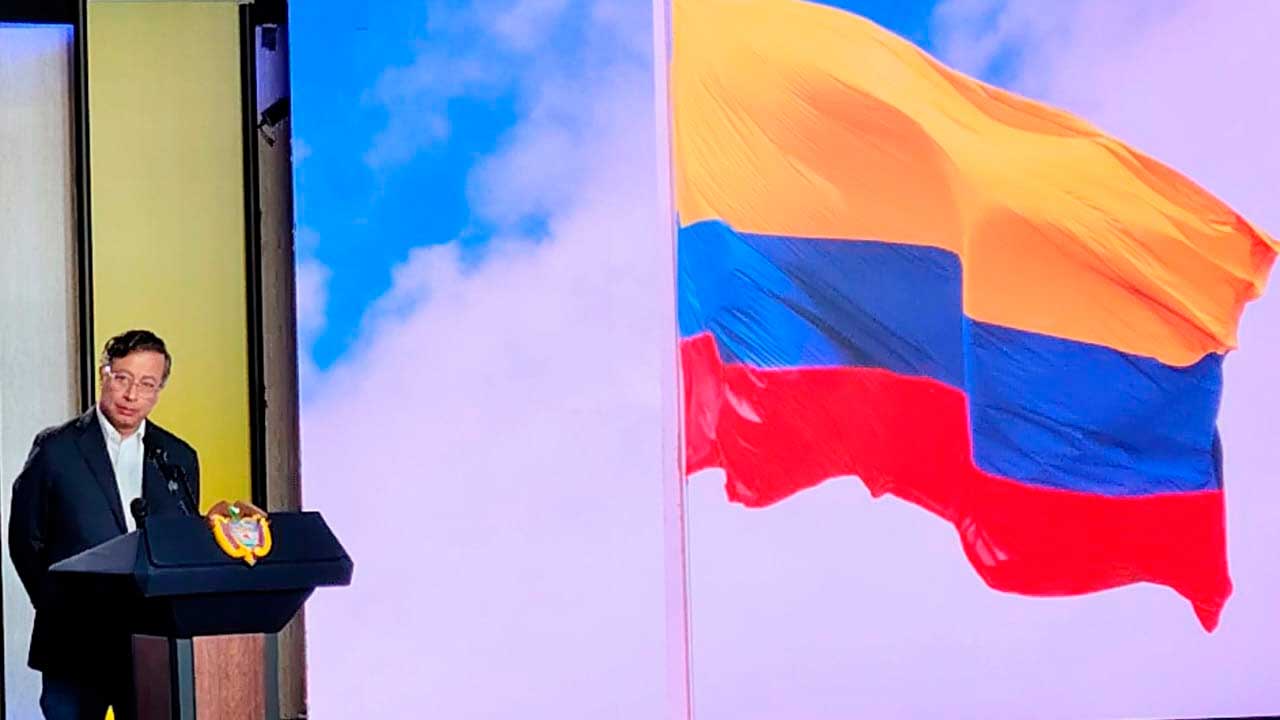
President Gustavo Petro held a press conference with international media, where he addressed Colombia’s anti-drug policy, cooperation with the United States, the climate crisis, and the country’s historic achievements in cocaine seizures.
The head of state began his remarks with a reflection on recent transformations in the cocaine market and the political tensions currently shaping the continent.
“Cocaine its developments and transformations in recent times—has acted upon a series of political tensions that already exist within the United States and throughout Latin America,” he said.
He also recalled the upcoming COP-30, to be held in Brazil, as a key stage for global debate on the climate crisis:
“It is an axis that has guided my political activity for decades and remains the top priority of Colombia’s foreign policy.”
The president referred to the militarization of the Caribbean Sea:
“The Caribbean Sea is crisscrossed by warships. Even a fisherman from Santa Marta was killed on his boat. And here begins our discussion, because these kinds of maneuvers, we believe, break international law. In such actions, the United States is committing extrajudicial executions.”
President Petro stressed that his administration has achieved unprecedented results in the fight against drug trafficking without resorting to excessive use of force:
“What my government has achieved is that we have been the most effective government in cocaine seizures in the history of the world. The government that has seized the most cocaine in history, since cocaine has existed and been illegal, is this government that I represent.”
At another point in his remarks, Petro explained that Colombia’s strategy focuses on distinguishing rural farmers from criminal structures:
“If we focus on the trafficker and not on the farmer who grows coca leaves, we will be more effective,” he said.
He recalled that since 1993 — when coca cultivation began in Colombia — the so-called “war on drugs,” carried out under the U.S.–Colombia alliance, has mainly targeted rural areas:
“Since that phase until now, the war on drugs has focused on hitting coca-growing fields. And there, the peasantry. Colombia’s farmers have centuries of military experience and respond to violence with violence.”
President Petro emphasized that the current drug trade operates through international financial networks rather than local territories:
“Today, the cocaine market is dominated by global actors who do not live on the speedboats shown on television, nor in the coca fields found in Colombia and other countries, nor even in this city. They live in the great cities of luxury around the world and move their capital—since they are multinationals—through the global circuits of finance.”
Faced with this reality, he explained Colombia’s approach:
“To seize cocaine outside the cultivation areas—on the highways where it is transported, in the warehouses where it is stored, and at the ports where it mostly departs.”
According to the president, most of the cocaine leaves Colombia hidden in large shipping containers departing from the ports of Buenaventura, Cartagena, Barranquilla, and Santa Marta.
Petro presented a map showing the evolution of coca crops in Colombia since 2018, explaining that the colors in the chart indicate the age of the plantations. He noted that the UN report, which estimated 252,000 hectares of coca in 2023, had been misinterpreted:
“The color of the coca leaf can determine its age. This report was what unleashed the crisis, and it was said that it justified the decertification of Colombia—precisely at the moment when we were providing the greatest assistance in this struggle and achieving record seizures. That seemed very paradoxical to us, and we naturally took it as an insult.”
Referring to Washington’s reaction, Petro summarized his frustration in a sentence that defined the tone of the conference:
“They withdraw support when we’re doing our best.”
He added that when the United States cuts its aid to Colombia, it is taking support away from itself.
The president said he personally discussed the issue with UN Secretary General António Guterres and described the interpretation of the data as an error:
“We told the research team about the enormous mistake they had made,” he said.
During the Q&A session, President Petro spoke about the role of the opposition in shaping perceptions of Colombia’s anti-drug policy:
“Trump doesn’t hear this from the chargé d’affaires who is here (…) nor from the experts in the United States who understand this issue, but rather from an ideological lobby deeply influenced by our political opposition—the Colombian far right—which has governed up to now.”
To conclude the meeting, the president highlighted Colombia’s latest diplomatic achievement:
“Through our ambassadors, we succeeded in having the United Nations Human Rights Commission unanimously approve that the fight against drugs must be linked to human rights. From that standpoint, what is being done today is absurd and constitutes a violation of citizens’ human rights.”